
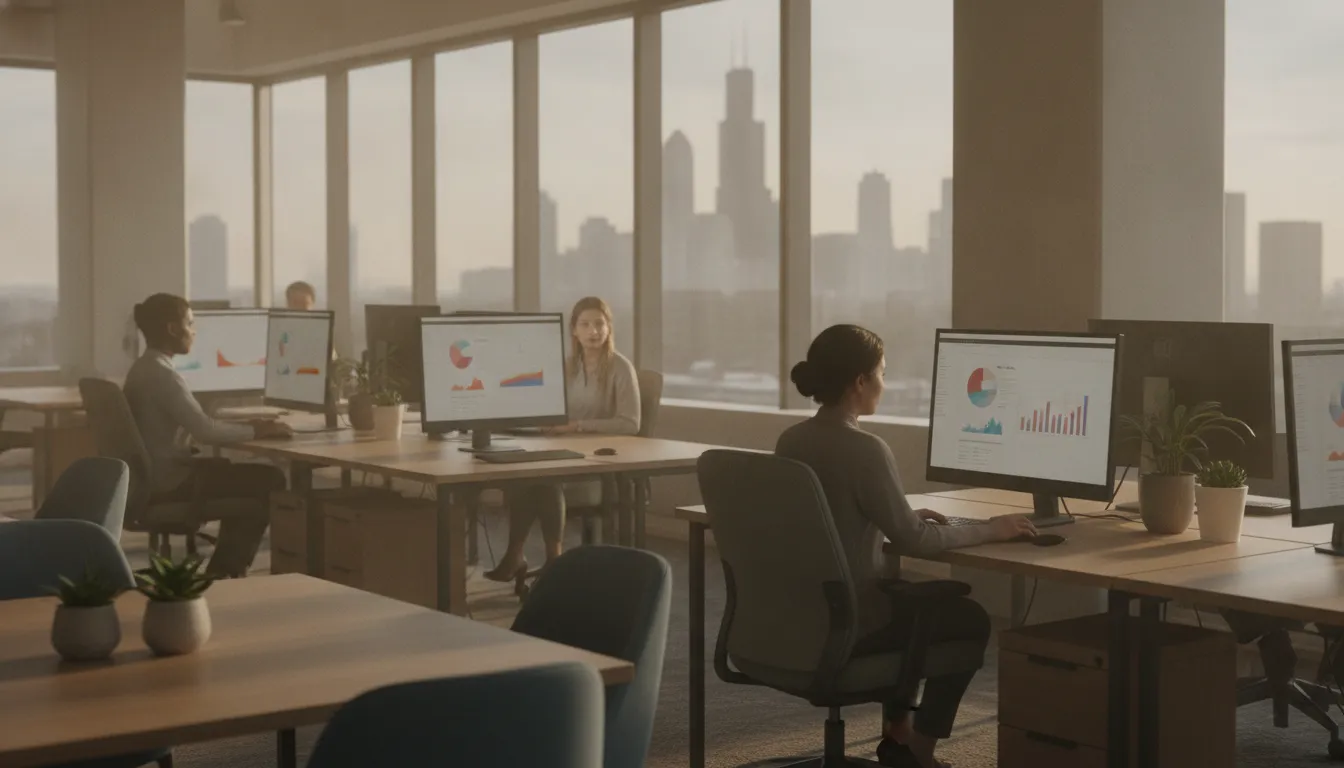
In a Chicago office, productivity can be affected by details employees notice all day: uneven temperatures, screen glare, and harsh sunlight. These distractions can make it harder to focus, even when the work environment looks modern and well managed.
Commercial window film can improve office productivity by helping control solar heat gain, reduce glare on screens, and create a more comfortable workspace while preserving natural light. The right film may also support privacy and protect interior furnishings from up to 99% of harmful UV rays.
For Chicago businesses, the goal is not to darken the office or create a temporary fix. Professional installation delivers a factory-finished look tailored to the building, its windows, and the people using the space. The first consideration is how thermal comfort influences focus and day-to-day performance.
Request a free estimate for your Chicago office.
The Link Between Thermal Comfort and Office Productivity
Temperature is not a minor preference in a busy office. When some employees are working beside sun-heated glass while others sit in cooler interior areas, comfort becomes inconsistent, and attention can suffer. An office that feels too warm, too cool, or constantly variable creates a steady background distraction. Employees may adjust clothing, move workstations, or interrupt tasks to find a more comfortable place to work.
Indoor environmental quality (IEQ) brings these conditions together. It includes temperature, humidity, ventilation, lighting, acoustics, and other factors that shape how people experience a building. Research published in the National Center for Biotechnology Information’s peer-reviewed archive found that improved IEQ was associated with self-reported productivity improvements. As well as reductions in perceived absenteeism and work hours affected by health conditions such as respiratory allergies, depression, and stress.
That does not mean window film can solve every indoor air or workplace issue. Proper ventilation, sound control, ergonomic design, and lighting still matter. The same research notes that poor IEQ can affect physical health through extreme temperatures, excess humidity, poor air quality, and insufficient ventilation. The practical lesson for office managers is to treat comfort as part of a coordinated building strategy. No single adjustment needs to do everything.
Solar exposure is one area where commercial window film can support that strategy. Applied to existing glazing by a professional installer, solar control film helps reduce solar heat gain at the window. That can lessen hot spots and temperature differences near sun-facing glass while helping the HVAC system maintain a more stable indoor environment. More consistent conditions give employees fewer reasons to pause, relocate, or compensate for an uncomfortable workspace.
Comfort also connects with attendance and sustained performance. When environmental conditions aggravate health symptoms, employees may miss work or lose productive hours. For employees who work at screens, the archived CDC/NIOSH guidance on rest breaks reports that short, strategically spaced breaks can reduce eyestrain and discomfort without reducing productivity. Managing heat and glare at the window complements those workplace practices. It removes avoidable sources of strain before they interrupt concentration.
For Chicago offices, the right commercial window film should be selected after reviewing window orientation, glass, interior use, and occupant concerns. The goal is not simply darker glass. It is a more predictable, comfortable workspace that supports focus while preserving the building’s professional appearance and useful daylight.
How Glare Affects Focus and Eye Strain at Work
Direct sunlight can turn a productive workstation into a visual obstacle. When glare reflects off a computer screen, employees may squint, shift their posture, tilt the monitor, or move repeatedly throughout the day to find a workable angle. Those small adjustments interrupt concentration and make routine screen-based work more physically demanding. In offices with large windows, the problem can change by the hour as sunlight moves across the building. So a desk that feels comfortable in the morning may become difficult to use in the afternoon.
Glare reduction is therefore more than an aesthetic improvement. It supports visual comfort by making monitors easier to view and reducing a persistent source of distraction. This is especially important in high-rise office buildings, where expansive glazing can bring valuable daylight and views while also exposing work areas to intense reflections. Glare management should be considered during an office improvement plan. It should not be treated as an individual employee problem solved with improvised blinds or frequent screen repositioning.
Why rest breaks are only part of the solution
Short, strategically spaced rest breaks can help reduce eyestrain for video display terminal operators without decreasing productivity, according to the National Institute for Occupational Safety and Health. Breaks remain a useful workplace practice, but they do not remove the glare source itself. If direct sunlight continues to wash across screens, employees may return from a break to the same reflection, squinting, and loss of focus.
A broader indoor environmental quality approach is useful here. Research on office environments connects conditions such as lighting, temperature, acoustics, and ventilation with occupant health and work experience. The academic review of indoor environmental quality and productivity also describes how poor environmental conditions can affect health and work hours. In practical terms, controlling screen glare is one part of creating a workspace that supports sustained attention.
How commercial window film can help
Professionally selected commercial window film can reduce harsh solar glare while preserving useful natural light and exterior views. The right film depends on the building’s orientation, glazing, workstations, and the times of day when reflections are worst. A consultation can identify affected areas and match the film type to the office’s visual comfort goals. For a high-rise building with extensive glass, that measured approach is more effective than applying the same treatment to every window without considering how sunlight enters each space.
Window film is not a substitute for sound workstation layout, monitor positioning, or sensible rest-break policies. It is a practical building-level measure that can make those practices easier to use consistently. Helping employees spend less time fighting their environment and more time focused on their work.
What Research Says About Temperature and Cognitive Performance
Temperature is not just a comfort preference in an office. It shapes how easily people can concentrate, manage mental effort, and stay engaged through the workday. When one side of a room feels noticeably warmer than another, employees may spend attention adjusting their environment instead of completing the task in front of them. Large windows can intensify that imbalance by allowing direct sunlight to create hot spots near perimeter desks.
Research on indoor environmental quality (IEQ) supports looking at the workplace as a connected system. A review found that improved IEQ was associated with self-reported productivity gains. Along with reductions in perceived absenteeism and work hours affected by asthma, respiratory allergies, depression, and stress. The findings are summarized in the peer-reviewed research available through the National Library of Medicine. This does not mean one building upgrade guarantees a specific productivity increase. It shows why temperature, air quality, lighting, acoustics, ergonomics, and other conditions deserve attention when an office is uncomfortable.
Temperature, lighting, and psychological health work together
Temperature control is one part of that broader picture. The same research identifies extreme temperatures, excess humidity, and insufficient ventilation as factors that can negatively affect physical health. It also connects inadequate lighting, acoustics, and ergonomic design with psychological health concerns such as stress and depression. In practical terms, a workplace can have efficient equipment and attractive finishes while still creating friction for employees if the indoor environment feels harsh, unstable, or visually tiring.
Commercial window film can address one important source of that friction: solar exposure at the glass. Solar-control film helps reduce solar heat gain at the window, which can support a more stable indoor temperature and reduce the cooling load placed on HVAC equipment. It is not a replacement for proper ventilation, maintenance, lighting design, or thermostat management. Instead, it is a targeted improvement that can help the building systems perform under less uneven conditions, especially in offices with strong afternoon exposure.
A productivity strategy should include healthy work habits
Environmental improvements also work best alongside reasonable work practices. In guidance summarized by the archived CDC and NIOSH resource on rest breaks, short, strategically spaced breaks helped reduce eyestrain and musculoskeletal discomfort for video display terminal operators without reducing productivity. That distinction matters: a well-managed office supports both the physical setting and the way people use it.
For Chicago office managers, the practical question is not whether window film alone can solve every productivity challenge. It is whether controlling heat and uneven sunlight exposure can remove a known source of distraction while preserving the professional, factory-finished look of the building. A site assessment and professional installation can identify where solar-control film is likely to provide the most meaningful improvement.
Why Chicago Office Managers Are Upgrading to Commercial Window Film
For Chicago office managers, window upgrades often need to solve several problems at once. They may be dealing with strong afternoon sunlight, uneven temperatures, rising cooling demand, and privacy concerns in glass-heavy workspaces. Commercial window film gives existing glass a targeted performance upgrade without requiring a full window replacement. By managing solar heat gain at the glass, the right film can help maintain a more stable indoor temperature and reduce the load placed on the HVAC system.
That combination matters in workplaces where comfort and operating efficiency are closely connected. High-performance solar film may help commercial properties reduce annual cooling energy consumption by 15% to 30%. Although actual results depend on the building, glazing, orientation, climate, and HVAC controls. This is one reason managers may evaluate a retrofit as part of a broader energy and greenhouse-gas reduction plan rather than treating it as a cosmetic change. See the commercial window film services overview for a closer look at the available applications.
Window film also lets managers match the treatment to each area of the building. Sullivan’s offers several commercial film categories, including solar control, decorative and privacy, and safety and security film. The practical differences are summarized below.
| Film type | Primary benefits | Best use |
|---|---|---|
| Solar control | Reduces solar heat gain, helps limit glare, supports more consistent comfort, and can lower cooling demand. | Exterior-facing offices, conference rooms, lobbies, and sun-exposed areas with hot spots or screen glare. |
| Decorative and privacy | Improves visual privacy while preserving useful natural light and providing a clean, factory-finished appearance. | Conference rooms, private offices, reception areas, healthcare spaces, and interior glass partitions. |
| Safety and security | Helps hold broken glass together, which can reduce the spread of fragments and add a layer of protection for people and property. | Entry areas, ground-floor glazing, storefronts, and offices where breakage or impact is a security concern. |
Privacy does not have to mean turning an office into a dark interior. Properly selected decorative or privacy film can reduce outside views while maintaining natural light. For offices that need privacy to change throughout the day, electric switchable film for office privacy provides another option. For risk-focused upgrades, managers can review commercial window film for security and discuss how the glazing, occupancy, and building layout affect the recommendation.
Sullivan’s Tinting brings family-owned, local experience to these decisions. Established in 1988, the company has served the Chicago metropolitan area and select Wisconsin markets for more than 36 years. A professional assessment can identify which elevations need solar control, where privacy is most important, and whether existing glass can be retrofitted instead of replaced. That retrofit approach is often less disruptive and less costly than replacing complete glass units, while still delivering a factory-finished look when professionally installed.
How Professional Commercial Window Film Installation Works
A successful upgrade starts with a plan that fits the building, the people who use it, and the schedule already in place. Commercial window film can be installed as a retrofit, so a property does not need structural glass replacement to improve solar control, privacy, or appearance. The process is designed to deliver a clean, factory-finished look while keeping disruption manageable.
- Consultation and free estimate. The first step is a conversation about the building’s priorities. A facility manager may want to reduce solar heat gain, improve visual comfort, add privacy, protect interior finishes, or strengthen glass. Sullivan’s Tinting reviews the property, discusses the desired outcome, and prepares a free estimate based on window measurements, film type, project complexity, and location. This consultative approach helps avoid selecting a film that solves one problem while creating another.
- Detailed measurements and site planning. Accurate measurements establish the scope and help the installation team plan access, work areas, and sequencing. The team can identify different exposures, glass conditions, frame details, and occupied areas that require special care. For a large office or multi-floor property, the work can be divided into phases. Phased scheduling allows a business to keep more of its space operational and limit interruptions to employees, visitors, and customers.
- Film selection for the building’s needs. There is no single film that performs identically in every commercial space. The recommendation may involve solar control film for heat and glare, decorative or privacy film for visibility concerns, or safety and security film for glass-retention needs. The right selection balances performance with the building’s design, daylight goals, and existing windows. A professional recommendation also accounts for how the film will look from inside and outside, rather than treating appearance as an afterthought.
- Professional installation. Window preparation and precise application are critical to the final result. Trained installers work carefully around furnishings, frames, occupants, and active workspaces. They control the installation conditions, align the material accurately, and finish the edges so the result looks integrated with the existing glass. DIY application can leave visible defects, poor adhesion, or an uneven appearance, and it may compromise expected performance. For a closer look at professional commercial window film installation, review the dedicated service page.
- Inspection and manufacturer-backed warranty. After installation, the finished work is reviewed for coverage, alignment, edges, and overall appearance. Professional installation is important because it helps the film perform as expected and supports manufacturer warranty protection. Sullivan’s Tinting has served the Chicago metropolitan area and select Wisconsin markets since 1988, bringing more than 36 years of local experience to commercial projects. For properties with extensive glazing or multiple buildings, learn more about large-scale commercial window film upgrades and phased project planning.
The result is a measured, professionally installed upgrade rather than a one-size-fits-all application. With the right sequence and film selection, a commercial retrofit can improve the workplace while respecting the daily operation of the building.
Request a free estimate for your Chicago office building.
Frequently Asked Questions
How does commercial window film improve employee productivity?
It can reduce glare on computer screens, moderate solar heat gain, and improve visual and thermal comfort. That gives employees a more consistent workspace with fewer avoidable distractions. Research on indoor environmental quality has associated improved conditions with self-reported productivity gains and fewer work hours affected by health symptoms. A review published in the National Center for Biotechnology Information provides additional context.
Can commercial window film help with office energy savings?
Solar-control film reduces the amount of heat entering through sun-exposed glass, which can lower cooling demand and help the HVAC system maintain a steadier indoor temperature. Results vary by glazing, orientation, building use, and existing equipment, so a site assessment is more useful than a generic savings promise. Sullivan’s Tinting recommends a custom evaluation based on your office windows and goals.
Does commercial window film offer security benefits for Chicago offices?
Yes, safety and security films are designed to help hold glass together if it breaks. Which can reduce the spread of shards and provide an added layer of protection for occupants and property. They serve a different purpose from solar-control or decorative films, so the right selection depends on the building’s exposure, access points, and security priorities.
Is professional installation required for commercial window film?
Professional installation is the appropriate choice for a commercial building. Proper surface preparation and application help produce a clean, factory-finished look, while professional installation also supports the manufacturer’s warranty. An experienced installer can recommend the right film category, coordinate work around office operations, and identify conditions that could affect long-term performance.
Ready to Improve Your Chicago Office Environment?
Every office has different window layouts, sunlight exposure, and comfort priorities. A professional review can help identify where commercial window film may reduce glare, support a more comfortable workspace, and fit your building’s needs.